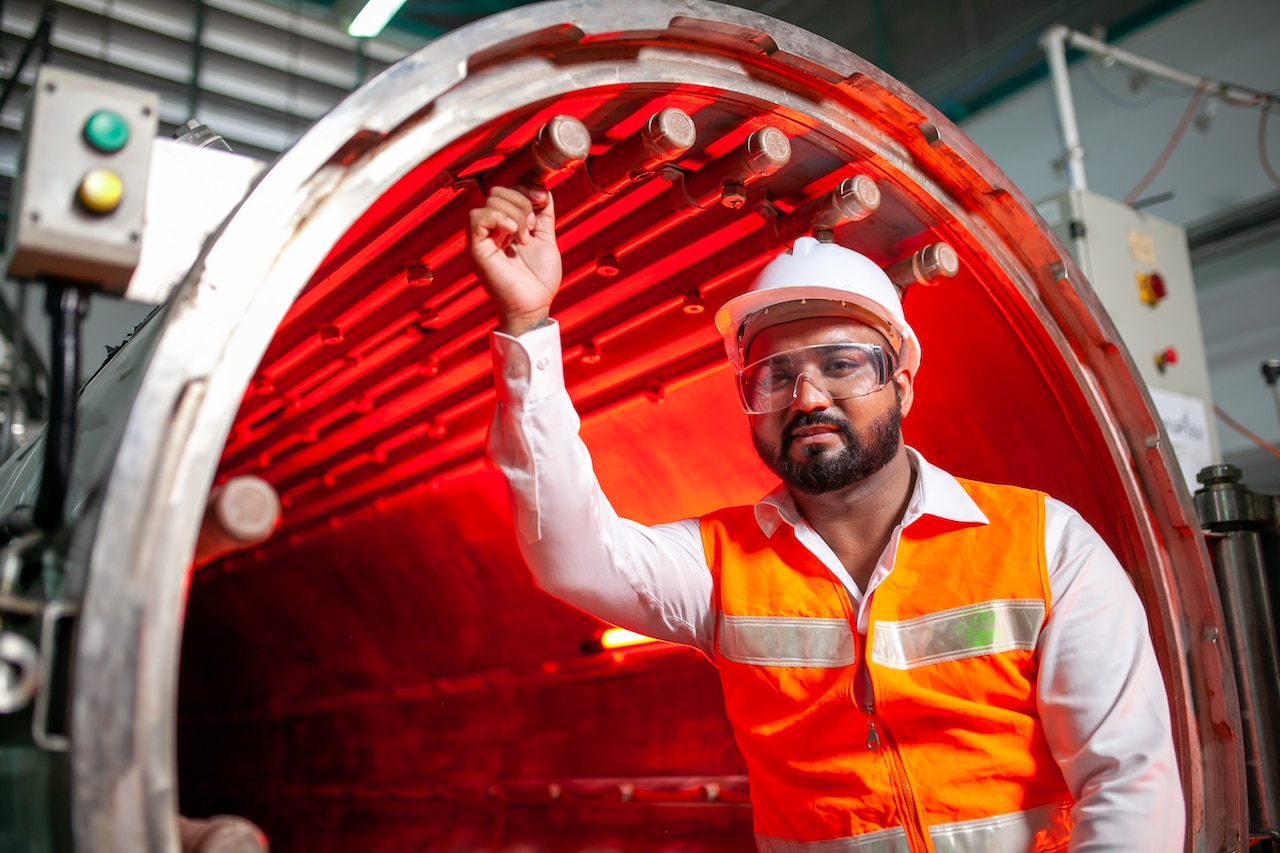
What Is Heat Treatment?
Heat treatment refers to a series of controlled heating and cooling processes applied to metal to modify its physical and mechanical properties — without changing its shape. For stainless steel components, the goal is typically to relieve residual stress, restore the alloy’s chromium-rich microstructure, and reduce susceptibility to corrosion, particularly in welded or heavily worked parts.
Unlike surface treatments such as electropolishing or passivation, heat treatment works at the microstructural level — addressing problems that can’t be resolved by chemistry or surface finishing alone.
Why Stainless Steel Sometimes Needs Heat Treatment
Stainless steel earns its corrosion resistance from a thin, chromium-rich passive oxide layer on its surface. But certain manufacturing processes can disrupt the underlying metallurgy in ways that undermine that protection:
- Welding generates intense, localized heat that can cause sensitization — a condition where chromium carbides precipitate at grain boundaries, depleting the surrounding metal of the chromium it needs to resist corrosion. This leaves the part vulnerable to intergranular corrosion.
- Cold working and forming introduce residual stresses into the metal that can accelerate stress corrosion cracking, particularly in chloride-rich or caustic environments.
- Machining and grinding can produce localized heat and stress concentrations that affect dimensional stability and long-term performance.
Heat treatment addresses each of these issues by carefully cycling the metal through specific temperature ranges to restore a stable, uniform microstructure.
Common Types of Heat Treatment for Stainless Steel
Solution Annealing
Also called solution heat treatment, this process heats the stainless steel to a high temperature (typically 1900°F–2100°F for austenitic grades) and then rapidly quenches it. The rapid cooling keeps carbides dissolved in the austenitic matrix, restoring a homogeneous microstructure and maximum corrosion resistance. Solution annealing is the most effective way to reverse sensitization caused by welding.
Stress Relieving
At lower temperatures than full annealing, stress relieving reduces residual internal stresses caused by cold working, forming, or machining — without significantly altering hardness or strength. This is particularly valuable for precision components where dimensional stability and resistance to stress corrosion cracking are critical.
Stabilization Annealing
For stainless steel grades stabilized with titanium or niobium (such as 321 or 347), a stabilization anneal promotes the formation of stable carbides, preventing the sensitization that can occur during service at elevated temperatures. This is common in heat exchanger tubing and high-temperature process equipment.
Industries and Applications Where Heat Treatment Matters
Heat treatment is especially important in applications where parts are:
- Welded and will be exposed to corrosive environments (pharmaceutical processing, marine, chemical handling)
- Heavily cold-worked in forming or deep-drawing operations
- Used at elevated temperatures where sensitization can occur over time
- Subject to stress corrosion cracking in chloride-rich environments (food processing, coastal/marine, medical)
- Dimensionally critical, where residual stress could cause warping or fatigue failure over time
Heat Treatment and Surface Finishing: A Powerful Combination
Heat treatment addresses the bulk properties of the metal. But for maximum corrosion resistance, it’s most effective when combined with a surface treatment that enhances the quality of the passive oxide layer itself.
At New England Electropolishing, we regularly work with customers whose parts have been heat treated prior to finishing. Electropolishing and passivation — our core services — are the ideal next step after heat treatment:
- Electropolishing removes the outermost layer of metal, eliminating any surface contamination introduced during heat treatment and dramatically improving the chromium-to-iron ratio at the surface.
- Citric Acid Passivation chemically enhances the passive layer, ensuring the freshly treated metal reaches its full corrosion-resistant potential.
Together, heat treatment + electropolishing or passivation delivers corrosion protection that is greater than the sum of its parts.
Not Sure Which Treatment Your Parts Need?
Every application is different. The right approach depends on your alloy grade, fabrication history, service environment, and performance requirements. Our team has decades of experience helping engineers and manufacturers in medical, pharmaceutical, semiconductor, marine, and food processing industries select and sequence the right finishing treatments.
Request a Quote or send us a free sample part and we’ll help you determine the best path to lasting corrosion resistance.
Heat treatment is one of several approaches to improving the corrosion resistance of stainless steel. Return to the full overview of Corrosion-Resistant Stainless Steel Treatments.