
Pickling vs. Passivation: Understanding Two Critical Stainless Steel Surface Treatments
When discussing corrosion resistance in stainless steel, two finishing processes are often mentioned together: pickling and passivation. While both treatments improve the performance of stainless steel and are commonly used after fabrication, welding, or machining, they serve very different purposes.
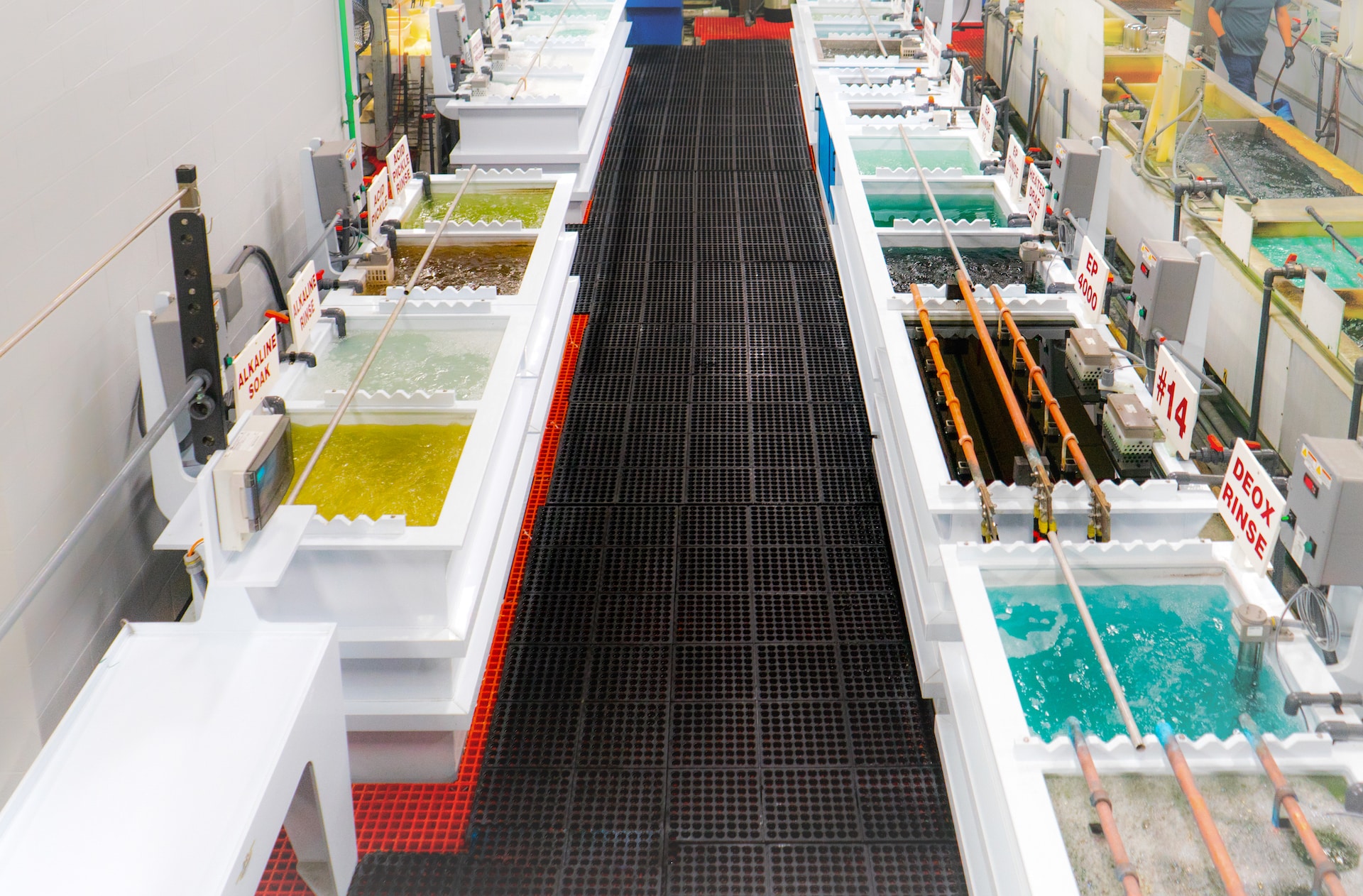
Pickling vs Passivation: What’s the Difference?
Misunderstanding the difference can lead to improper specifications, unnecessary costs, or reduced corrosion performance in the field. Understanding when to use pickling, when to use passivation, and when both processes are beneficial is essential for manufacturers, fabricators, and engineers working with stainless steel.
The Key Difference at a Glance
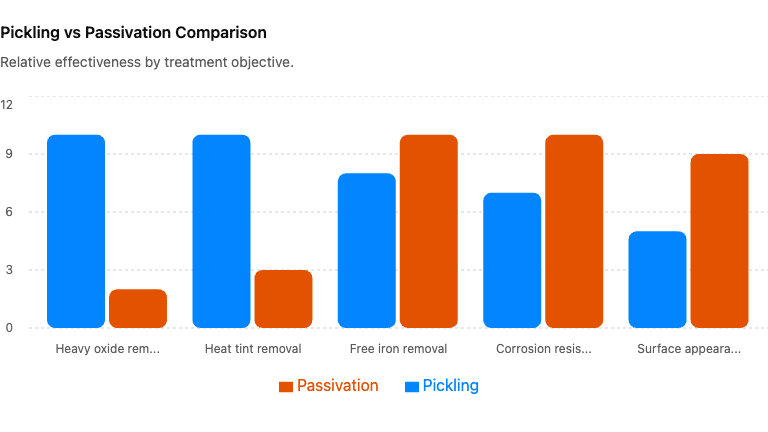
Pickling vs Passivation Comparison. Relative effectiveness by treatment objective.
Acid Pickling for Stainless Steel
Pickling is an aggressive chemical treatment used to remove:
- Weld scale
- Heat tint
- Heavy oxides
- Surface discoloration
- Embedded contaminants
It is primarily a cleaning and oxide-removal process.
Passivation
Passivation is a chemical treatment that removes:
- Free iron
- Surface contamination
- Residual machining contaminants
It is primarily a corrosion resistance enhancement process.
Understanding Acid Pickling
Pickling uses strong acid solutions—typically combinations of nitric acid and hydrofluoric acid—to dissolve oxides and heat-affected surface layers created during welding, heat treatment, or fabrication. For more information, view our post about acid pickling for stainless steel.
The process essentially removes damaged surface material and exposes fresh stainless steel beneath.
Pickling Is Commonly Used For:
- Welded stainless steel fabrications
- Pressure vessels
- Tanks and piping systems
- Pharmaceutical equipment
- Food processing systems
- Heavy industrial fabrications
Benefits of Pickling
✓ Removes weld discoloration
✓ Eliminates heat tint
✓ Removes heavy oxide scale
✓ Prepares surfaces for further finishing
✓ Restores a uniform stainless steel surface
Limitations of Pickling
✗ Does not maximize corrosion resistance by itself
✗ Uses highly aggressive chemicals
✗ May affect surface appearance
✗ Requires proper handling and waste treatment
Understanding Passivation
Passivation is a chemical treatment designed to remove free iron and contaminants from the stainless steel surface without significantly affecting the base material.
The goal is to promote the formation of a strong chromium-rich passive layer that protects the stainless steel from corrosion. To learn more about the science behind chemcial passivation, please view our post about What is Passivation?
Modern chemical passivation methods typically utilizes:
Passivation Is Commonly Used For:
- Medical devices
- Aerospace components
- Food processing equipment
- Semiconductor systems
- Pharmaceutical manufacturing
- Precision machined parts
Benefits of Passivation
✓ Improves corrosion resistance
✓ Removes free iron contamination
✓ Preserves dimensional tolerances
✓ Does not significantly alter surface finish
✓ Supports ASTM compliance requirements
Limitations of Passivation
✗ Does not remove heavy weld scale
✗ Cannot remove significant heat tint
✗ Not intended for oxide removal
✗ Requires a relatively clean surface to be most effective
Why Heat Tint Matters
One of the most important distinctions between pickling and passivation involves weld heat tint.
When stainless steel is welded, elevated temperatures create visible oxide layers around the weld area.
Heat tint:
- Reduces corrosion resistance
- Alters surface chemistry
- Can become a corrosion initiation point
Because heat tint is a thick oxide layer, passivation alone often cannot remove it effectively.
This is where pickling becomes necessary.
Typical Post-Weld Process
For welded stainless steel fabrications, the sequence often looks like:
- Welding
- Pickling
- Rinsing and cleaning
- Passivation
- Final inspection
This combination removes oxides first and then restores maximum corrosion resistance.
Surface Effects Comparison
| Characteristic | Pickling | Passivation |
|---|---|---|
| Removes heat tint | Yes | Limited |
| Removes weld scale | Yes | No |
| Removes free iron | Somewhat | Yes |
| Improves corrosion resistance | Moderate | Excellent |
| Alters surface appearance | Often | Minimal |
| Changes dimensions | Slightly | Negligible |
| Suitable after machining | Sometimes | Yes |
| Suitable after welding | Yes | Yes |
When Should Pickling Be Used?
Pickling is often recommended when:
- Heavy welding has occurred
- Heat tint is visible
- Oxide scale is present
- Surface discoloration must be removed
- Fabricated assemblies require restoration
Examples include:
- Tanks
- Pressure vessels
- Process piping
- Stainless steel skids
- Structural fabrications
When Should Passivation Be Used?
Passivation is often recommended when:
- Components have been machined
- Surface contamination may exist
- Corrosion resistance is critical
- Medical or sanitary requirements apply
- ASTM specifications require passivation
Examples include:
- CNC machined parts
- Valves
- Fittings
- Medical devices
- Semiconductor components
- Aerospace hardware
Can Pickling Replace Passivation?
Not completely.
While pickling removes oxides and cleans the surface, it is not specifically intended to optimize the chromium-rich passive layer that provides stainless steel with its corrosion resistance.
For many critical applications, passivation is still recommended after pickling.
Can Passivation Replace Pickling?
Not always.
If heavy weld scale or heat tint exists, passivation may not be sufficient.
Passivation works best on relatively clean surfaces. Thick oxide layers often require pickling or another cleaning process before passivation can be effective.
Which Process Is Better?
Neither process is inherently “better” because they serve different purposes.
Choose Pickling When:
- Removing weld scale
- Eliminating heat tint
- Restoring heavily oxidized surfaces
- Preparing weldments for additional treatment
Choose Passivation When:
- Improving corrosion resistance
- Removing free iron contamination
- Finishing machined components
- Meeting sanitary or regulatory requirements
Choose Both When:
- Welded stainless steel requires maximum corrosion resistance
- Fabricated assemblies operate in aggressive environments
- Regulatory standards require the highest level of surface integrity
The Bottom Line
Although they are frequently discussed together, pickling and passivation are fundamentally different stainless steel treatments.
Pickling removes oxides, weld scale, and heat tint. Passivation removes free iron and enhances the protective chromium oxide layer that gives stainless steel its corrosion resistance.
In many manufacturing environments, the most effective approach is not choosing one or the other—but using both processes strategically. Pickling prepares the surface, while passivation optimizes corrosion resistance. Together, they help ensure stainless steel components perform reliably in demanding industrial, sanitary, and high-purity applications.
What is Passivation?
Passivation is a chemical treatment process used to enhance the natural corrosion resistance of stainless steel. During manufacturing, machining, welding, and handling, contaminants such as free iron can become embedded in the metal’s surface, increasing the risk of rust and corrosion. Passivation removes these contaminants and promotes the formation of a clean, protective chromium oxide layer that helps shield the stainless steel from environmental attack. Widely used in medical, pharmaceutical, food processing, aerospace, and industrial applications, passivation is a critical finishing process for improving performance, cleanliness, and long-term durability.
Passivation Resources
Passivation is only effective if it achieves its intended purpose—removing free iron contamination and restoring the stainless steel's natural passive layer. But how...
When discussing corrosion resistance in stainless steel, two finishing processes are often mentioned together: pickling and passivation. While both treatments improve...
Laser cutting is one of the most efficient and precise methods for fabricating stainless steel components, but the process can leave behind more than just clean cut...
Yes—small precision machined parts can absolutely be passivated, and in many industries, it’s not just possible but essential for performance, reliability, and...

Yes—stainless steel can still rust after passivation, but it’s important to understand what passivation does (and doesn’t do) to know why. Passivation is a chemical...
Stainless steel is known for its corrosion resistance, strength, and clean appearance—but manufacturing processes can compromise those benefits. A common question from...
Stainless steel is widely chosen for its strength, durability, and corrosion resistance—but not all stainless steel performs the same in every environment. A common...
In precision manufacturing, even the smallest surface imperfection can create outsized problems. Burrs—those tiny raised edges or fragments of metal left behind after...
When engineers and manufacturers talk about stainless steel performance, the conversation often centers around alloy selection, mechanical strength, or surface...