
Understanding ASTM A967 Acceptance Tests: How Passivation Quality Is Verified
Passivation is only effective if it achieves its intended purpose—removing free iron contamination and restoring the stainless steel’s natural passive layer. But how can manufacturers verify that a passivated component will actually resist corrosion in service?
That’s where ASTM A967, the industry standard for the chemical passivation of stainless steel parts, comes into play. In addition to outlining approved passivation methods, ASTM A967 defines several acceptance tests used to verify that passivation has been successful.
Depending on the application, material, and customer requirements, manufacturers may specify one or more of these tests to ensure stainless steel components meet performance expectations after passivation services.
What Is ASTM A967?
ASTM A967, Standard Specification for Chemical Passivation Treatments for Stainless Steel Parts, establishes industry-recognized procedures for chemically passivating stainless steel components.
The standard covers:
- Approved citric acid passivation methods
- Approved nitric acid passivation methods
- Surface preparation requirements
- Cleaning procedures
- Acceptance testing methods
- Documentation requirements
One important distinction is that ASTM A967 does not require every part to undergo every acceptance test. Instead, the purchaser or engineering specification determines which testing method is appropriate for the application.
Why Acceptance Testing Matters
Simply immersing a part in a passivation solution doesn’t guarantee success.
Surface contamination may remain if:
- Parts weren’t properly cleaned before passivation.
- Embedded free iron wasn’t fully removed.
- Cross contamination occurred during fabrication.
- Weld scale or heat tint remained on the surface.
- The incorrect passivation process was used.
Acceptance testing provides objective evidence that the stainless steel surface has been properly cleaned and is capable of forming a durable chromium oxide layer.
Common ASTM A967 Acceptance Tests
1. Water Immersion Test
The Water Immersion Test is one of the simplest methods for evaluating passivated stainless steel.
How It Works
After passivation, components are immersed in clean distilled or deionized water for a specified period.
The parts are then inspected for signs of:
- Rust
- Discoloration
- Surface staining
- Corrosion products
Best Applications
- General industrial components
- Food processing equipment
- Medical instruments
- Light-duty corrosion environments
Advantages
- Simple procedure
- Low cost
- Easy to perform
- Non-destructive
Limitations
Because the test is relatively mild, it may not reveal extremely small amounts of residual iron contamination that could become problematic in aggressive environments.
2. High Humidity Test
The High Humidity Test exposes passivated components to warm, humid conditions that accelerate corrosion if contamination remains.
How It Works
Parts are placed in a humidity chamber with controlled temperature and high relative humidity for an extended period.
Inspectors then look for:
- Surface rust
- Oxide staining
- Corrosion initiation
Best Applications
- Medical devices
- Pharmaceutical equipment
- Cleanroom components
- Precision-machined stainless steel
Advantages
- Simulates real-world atmospheric exposure
- Excellent for detecting surface contamination
- Non-destructive
Limitations
Testing requires specialized environmental equipment and can take several days.
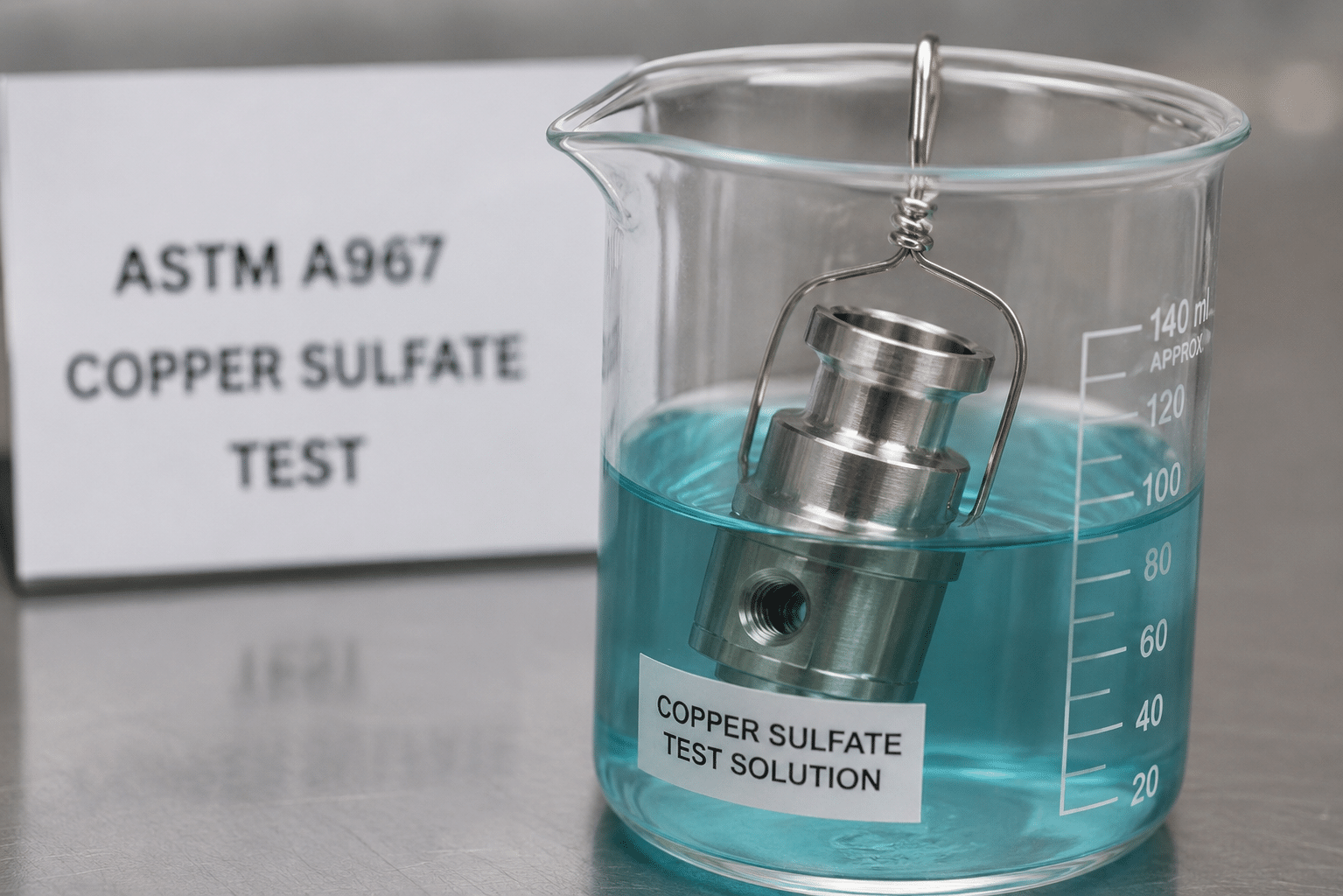
3. Copper Sulfate Test
The Copper Sulfate Test is specifically designed to detect free iron contamination remaining on the stainless steel surface.
How It Works
A copper sulfate solution is applied to the passivated component.
If free iron is present, a chemical reaction causes copper to deposit onto the contaminated areas.
No copper deposits indicate a properly passivated surface.
What It Detects
- Embedded carbon steel particles
- Iron contamination
- Incomplete passivation
- Cross contamination from fabrication
Best Applications
- Machined parts
- Welded assemblies
- Fabricated stainless steel
- Components exposed to carbon steel tooling
Advantages
- Sensitive to free iron
- Fast results
- Widely recognized
- Relatively inexpensive
Limitations
The Copper Sulfate Test is not appropriate for all stainless steel grades, particularly certain ferritic and martensitic alloys where false indications may occur.
4. Salt Spray (Fog) Test
Among the most demanding acceptance tests, the Salt Spray Test evaluates corrosion resistance under highly accelerated conditions.
How It Works
Parts are placed inside a controlled chamber where they are continuously exposed to a fine salt mist.
Testing may continue for:
- 24 hours
- 48 hours
- 96 hours
- Several hundred hours depending on customer specifications
Inspectors evaluate:
- Rust formation
- Surface staining
- Pitting
- Corrosion progression
Best Applications
- Marine hardware
- Aerospace components
- Outdoor equipment
- Defense applications
- Coastal infrastructure
Advantages
- Accelerated corrosion testing
- Highly repeatable
- Excellent comparative test
- Demonstrates long-term corrosion resistance
Limitations
Salt spray testing does not perfectly replicate real-world service conditions and is generally reserved for applications requiring enhanced corrosion verification.
5. Free Iron Testing
The primary goal of passivation is the removal of free iron contamination from stainless steel surfaces.
Several ASTM-recognized methods evaluate whether free iron remains after processing.
Common techniques include:
- Copper sulfate testing
- Ferroxyl testing
- Water immersion evaluation
- Specialized laboratory analysis
Free iron testing is particularly valuable for components used in:
- Medical manufacturing
- Semiconductor production
- Pharmaceutical equipment
- Food processing
- High-purity process systems
Comparing ASTM A967 Acceptance Tests
| Test Method | Detects | Typical Applications | Relative Sensitivity |
|---|---|---|---|
| Water Immersion | Surface corrosion | General industrial use | Moderate |
| High Humidity | Atmospheric corrosion | Medical, pharmaceutical | High |
| Copper Sulfate | Free iron contamination | Machined & fabricated parts | Very High |
| Salt Spray | Long-term corrosion resistance | Marine, aerospace, defense | Very High |
| Free Iron Testing | Embedded iron contamination | Critical applications | Highest |
Choosing the Right Test
The appropriate acceptance test depends on several factors, including:
- Stainless steel grade
- Intended service environment
- Industry standards
- Customer specifications
- Regulatory requirements
- Risk of contamination
For example:
- A food processing component may only require water immersion testing.
- A surgical instrument may require free iron verification.
- Marine hardware may undergo extensive salt spray testing.
- Semiconductor equipment often requires stringent contamination testing and documentation.
Passivation Is Only One Step
Even the best passivation process cannot compensate for poor fabrication practices.
Successful corrosion resistance begins with:
- Proper machining
- Thorough cleaning
- Weld scale removal
- Elimination of carbon steel contamination
- Appropriate passivation chemistry
- Verification through ASTM A967 acceptance testing
For components requiring the highest levels of cleanliness and corrosion resistance, many manufacturers also choose electropolishing, which removes a thin layer of metal while producing an exceptionally smooth, contaminant-free surface before or in conjunction with passivation.
Partner with New England Electropolishing
At New England Electropolishing, we help manufacturers produce stainless steel components that meet demanding quality and corrosion-resistance requirements across medical, pharmaceutical, aerospace, food processing, semiconductor, and industrial applications.
Whether your project requires citric acid passivation, nitric acid passivation, or electropolishing, our team can recommend the appropriate finishing process based on your material, application, and performance requirements.
Related Resources
- What Is Passivation?
https://neelectropolishing.com/passivation/what-is-passivation/ - Passivation Services
https://neelectropolishing.com/passivation/ - Citric Acid Passivation
https://neelectropolishing.com/passivation/citric-acid-passivation/ - Nitric Acid Passivation
https://neelectropolishing.com/passivation/nitric-acid/ - Electropolishing Services
https://neelectropolishing.com/electropolishing/
Passivation Resources
Passivation is only effective if it achieves its intended purpose—removing free iron contamination and restoring the stainless steel's natural passive layer. But how...
When discussing corrosion resistance in stainless steel, two finishing processes are often mentioned together: pickling and passivation. While both treatments improve...
Laser cutting is one of the most efficient and precise methods for fabricating stainless steel components, but the process can leave behind more than just clean cut...

Yes—small precision machined parts can absolutely be passivated, and in many industries, it’s not just possible but essential for performance, reliability, and...

Yes—stainless steel can still rust after passivation, but it’s important to understand what passivation does (and doesn’t do) to know why. Passivation is a chemical...
Stainless steel is known for its corrosion resistance, strength, and clean appearance—but manufacturing processes can compromise those benefits. A common question from...
Stainless steel is widely chosen for its strength, durability, and corrosion resistance—but not all stainless steel performs the same in every environment. A common...
In precision manufacturing, even the smallest surface imperfection can create outsized problems. Burrs—those tiny raised edges or fragments of metal left behind after...
When engineers and manufacturers talk about stainless steel performance, the conversation often centers around alloy selection, mechanical strength, or surface...